Somalia’s Carbon Challenge and Opportunity
Somalia contributes less than 0.03% of global greenhouse gas emissions yet faces some of the world’s harshest climate impacts – from prolonged droughts and flash floods to soil degradation and food insecurity. While the country’s total emissions are low, the need for climate action is high. Across Somalia, local actors are stepping up voluntarily, taking climate responsibility into their own hands long before national carbon policies or market systems are fully established.
Among these front-runners is Greenlife Agribusiness LTD, a Somali-founded company that has spent more than a decade proving that sustainability can grow from the ground up.
Voluntary Climate Action Since 2013
When Greenlife Agribusiness LTD was established in 2013, sustainability was not yet a mainstream idea in Somalia. But from the start, our goal was clear — to green Somalia’s future through clean energy, regenerative agriculture, and sustainable landscaping.
Over the past five years, our voluntary climate efforts have led to measurable results:
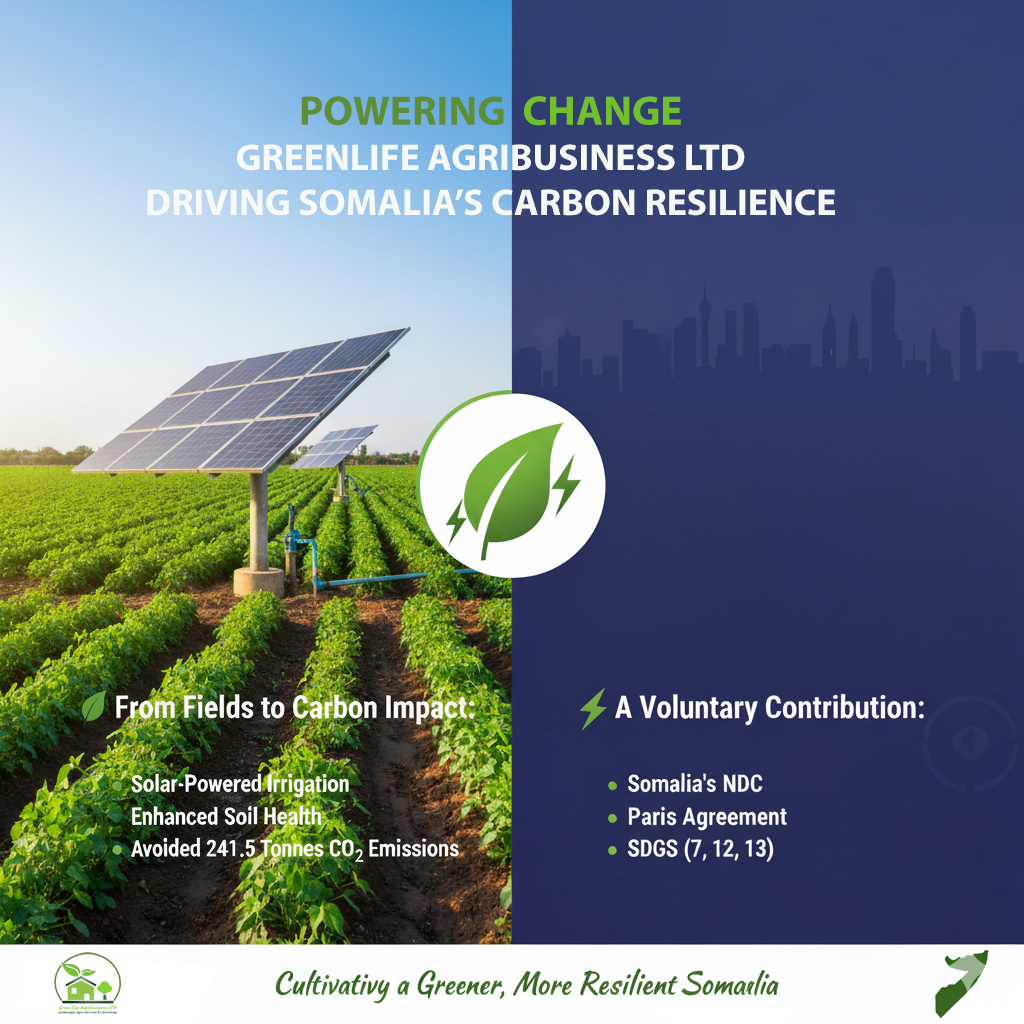
✅ Avoided over 91,000 litres of fossil fuel, equivalent to 241.5 metric tons (MT) of CO₂ emissions, by replacing diesel pumps with solar-powered irrigation systems.
✅ Enhanced carbon sequestration through thousands of trees and plants established in public, institutional, and tourism landscapes.
✅ Reduced methane and CO₂ emissions by converting organic waste and coconut husks into two local eco-products — Suuban Organic Fertilizer and AfyaPeat (Cocopeat).
✅ Trained more than 1,000 farmers across the country on climate-smart Agriculture practices and sustainable landscaping.
These results reflect a simple truth: meaningful climate action does not always begin with policy — it often begins with purpose.
Turning Waste Into Climate Solutions
At the heart of our sustainability model is the belief that waste can be transformed into value. Through innovation, we’ve developed two flagship products designed to reduce emissions while improving soil health and productivity.
- Suuban Organic Fertilizer transforms organic waste into compost, preventing methane emissions that would otherwise occur in open dumps.
- AfyaPeat (Cocopeat) converts coconut husks into a sustainable growing medium, reducing pressure on peatland ecosystems and supporting local horticulture.
Together, these initiatives create a circular economy model that keeps carbon in the ground, cuts emissions, and provides affordable, eco-friendly alternatives for farmers.
Greening Somalia, One Tree at a Time
Landscaping has been part of Greenlife’s DNA since our early days. For over 13 years, we’ve been turning bare plots into thriving green spaces — from roadsides and institutions to hospitality and tourism sites. Each tree we plant, each garden we design, and each space we restore is more than beautification; it’s a carbon sink in action. These living landscapes help clean the air, regulate local temperatures, and restore biodiversity in Somalia’s urban environments.
A Voluntary Commitment to Carbon Responsibility
Unlike traditional emitters that seek to offset their pollution, Greenlife’s mission has always been preventive – to reduce emissions before they occur and to build systems that naturally sustain themselves.
Our approach embodies the spirit of voluntary carbon contribution:
- Acting before being regulated.
- Reducing before offsetting.
- Leading through innovation rather than compliance.
As Somalia develops its national carbon strategies and explores carbon market mechanisms, Greenlife’s track record offers a ready example of how local enterprises can generate real, measurable carbon benefits.
Our work aligns strongly with three key frameworks:
- Somalia’s Nationally Determined Contributions (NDC):
Greenlife supports Mitigation Approach 7.1.2, which calls for decentralized renewable energy hubs for irrigation and agricultural productivity. Our solar-powered irrigation systems directly advance this goal by replacing fossil fuel use and cutting emissions in agriculture. - The Paris Agreement:
We uphold the principles of the Paris Agreement by taking bottom-up, cooperative climate action that strengthens adaptation and resilience. In line with Article 6, our work demonstrates how private initiatives can complement national efforts to limit global warming to 1.5°C. - The Sustainable Development Goals (SDGs):
Every Greenlife initiative contributes to the global goals — - SDG 7 – Affordable and Clean Energy: expanding renewable energy access for farmers.
- SDG 12 – Responsible Consumption and Production: advancing circular economy through organic and peat-free products.
- SDG 13 – Climate Action: reducing emissions and building climate resilience in communities.
Together, these alignments show that Somalia’s private sector can be a driving force in achieving climate goals – not only responding to national frameworks but shaping them through innovation, leadership, and results.
A Green Future, Grown Voluntarily
Somalia’s journey toward a low-carbon future will depend on local leadership, community innovation, and voluntary action.
At Greenlife Agribusiness LTD, we remain committed to this path — growing food sustainably, powering farms with clean energy, turning waste into resources, and greening the landscapes that define our cities. We are proud to be part of Somalia’s evolving climate story — proving that even in one of the world’s most climate-vulnerable nations, solutions can thrive when built on commitment, creativity, and care for the planet.
Greenlife Agribusiness LTD – The Greening of Somalia’s Future. 🌱🇸🇴